
If you know me, you know October is my favorite month of they year: the State Fair, Dallas Stars Hockey, Halloween, my birthday…However, October is also the time of the school year when things start to go a little off the rails especially for first year teachers. Time to pour that cup of tea.

The Honeymoon is Over
This past week I met with our first year teachers and reminded them of their “Hero’s Journey” aka The Phases of a First Year Teacher. It was important they understood the phase they were about to enter if they hadn’t started already.
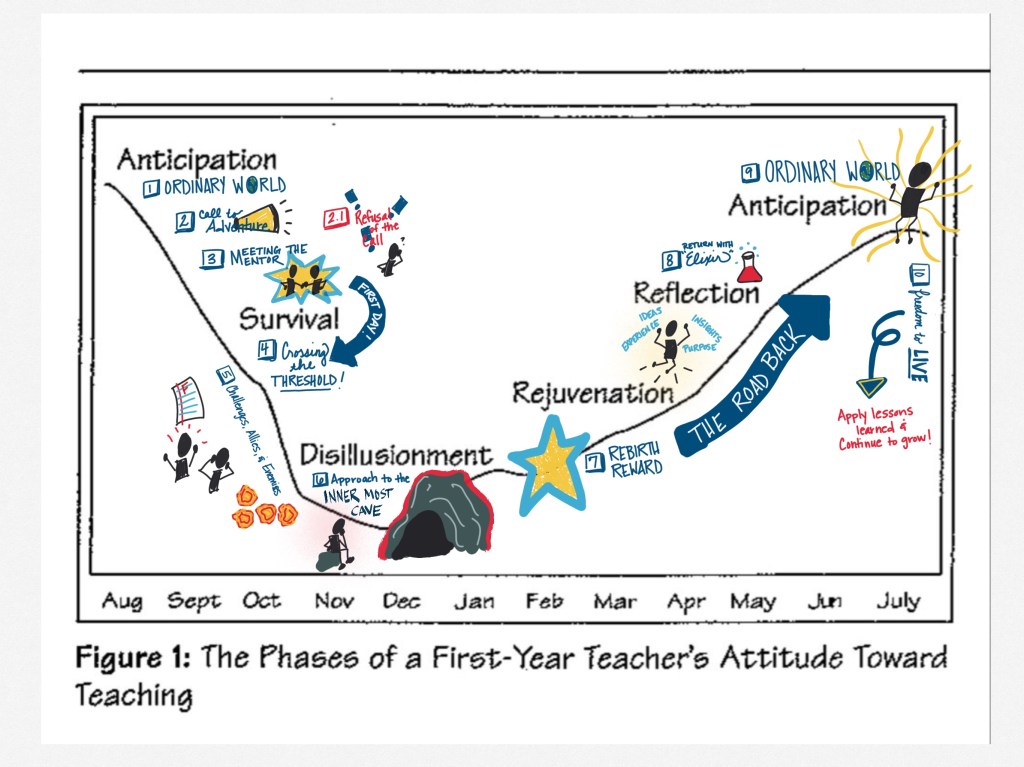
It is important to think back to the Anticipation Phase. Do you remember that first-day-of-school energy? The perfectly organized classroom, the fresh lesson plans, the feeling that you were about to change the world? Well, now it’s October. Your desk is buried under a mountain of papers, your students have discovered their ‘outside voices,’ and changing the world feels a lot like just trying to make it to Friday. Seriously.
If this sounds familiar, you are not alone. You are not failing. You are experiencing a completely normal and predictable stage in a teacher’s first year: the Disillusionment Phase. The initial adrenaline has worn off, and the reality of this marathon has set in. But here’s the good news: you can, and you will, get through this. It’s about shifting from surviving to steering.
Why October is so Hard
- The Grading Mountain: The sheer volume of student work becomes real. What felt manageable in September now feels like an avalanche with no end in sight.
- The Behavior Shift: Students are comfortable. They know the routines, which means they also know how to test them. What worked flawlessly a month ago might be met with chatter and off-task behavior now.
- The Pacing Panic: You look at the district curriculum map and a wave of panic hits. “I’m already two weeks behind! How will I ever catch up?” This pressure can feel immense and isolating.
Under this stress, it is easy to default to systems and ideas that we experienced as students even if they weren’t the best or unlike the routines we tried to implement in our class.
Tame the Grading Moutain
It took me a few years to realize that not everything assigned needs to receive a grade. Actually, I also learned to be more strategic in the amount of work I assigned. This section will be a bit longer than the others because grades are such a large part of a teacher’s life. It is important to remember:
- Not every assignment is a masterpiece. Some assignments are for practice, exploration, or review, and don’t require in-depth feedback.
- Strategic feedback is more effective. Overwhelming students with corrections on every single error can be less effective than targeted feedback on one or two key areas.
Try addressing that grading pile this way:
- One Deep: Choose one assignment that is truly meaningful. Grade that single assignment with intentional, helpful feedback. This allows you to assess a key skill without burning out.
- One Done: Choose one other assignment—perhaps daily work or a warm-up—and grade it simply for completion. A checkmark, a sticker, a quick scan to see it was attempted. That’s it. You’re acknowledging their effort without spending hours on it.
Please don’t misunderstand, I am not suggesting completion grades for everything. It is about understanding the value of grading an assignment. This approach honors both your time and your students’ learning. You’re still getting a clear picture of their progress while freeing up hours of your week. Below are examples of what this can look like.
1. The “One Deep” Assignment
This is the assignment you choose to assess with rigor, detail, and personalized feedback. This is where you invest your precious time and energy.
- What it looks like: This is likely a summative assessment, a key project, a formal essay, or a multi-step problem that reveals a deep understanding of a major standard or concept. It’s an assignment that tells you a lot about a student’s learning.
- How you approach it:
- Use a Rubric: Before you even assign the work, have a clear rubric. This not only makes your grading faster and more consistent but also shows students exactly what success looks like.
- Focus Your Comments: You don’t have to mark every single error. Limit your feedback to 2-3 of the most important concepts or skills. For example, on an essay, you might choose to only comment on the thesis statement and the use of evidence, even if there are grammatical errors. This prevents students from feeling overwhelmed and helps them focus their efforts on the most critical areas for improvement.
- Keep a Comment Bank: You’ll likely find yourself writing the same comments over and over. Keep a running document of your most frequent feedback and just copy-paste, or use abbreviations that you’ve shared with students beforehand.
2. The “One Done” Assignment
This is the work you grade for completion or effort. Its main purpose might be practice, formative assessment (for you), or simply holding students accountable for daily work.
- What it looks like: This could be homework, classwork, warm-ups, exit tickets, or notes. It’s the daily practice that reinforces learning but doesn’t need a fine-toothed comb.
- How you approach it:
- The Quick Scan: As students work or as you walk around the room, you can mentally note who is on track. This “in-the-moment” feedback is often more powerful than a written comment a week later.
- Simple Marks: Use a simple system like a check, check-plus, and check-minus to quickly indicate the level of effort or completion.
- Completion Grade: Simply check that the work was done and give full points for the attempt. This acknowledges student effort without requiring you to spend hours on feedback they may not even read.
- Peer “Grading”: For assignments like vocabulary quizzes or multiple-choice questions, have students Think-Pair-Share their answers and learn with each other. This provides immediate feedback for them and saves you significant time.
Hit the “Procedural Reset” Button
Don’t be afraid to stop and reteach. Consistent routines and procedures are not a one-and-done lesson; it’s a constant practice. This matters because the more consistent the routines and procedures, the fewer behavior issues you end up with.
- Identify One Thing: Don’t try to fix everything at once. What is the one procedure that is causing the most disruption? Is it turning in work? Transitioning between activities? Getting out supplies? I had new teachers write down one symphony routine and one cacophony routine. After sharing with a partner and looking at ways to reinforce a routine, the teachers revisited their cacophony routine and decided on one concrete step they could take to address it.
- Reteach and Rehearse: Dedicate 5-10 minutes to explicitly reteaching that single procedure, just like you did in August. Have students practice it correctly. Make it positive and upbeat, not punitive.
- Reinforce Relentlessly: For the rest of the week, pour your energy into positively acknowledging every student who does that one procedure correctly. “I love how quickly and quietly Group 3 got their materials out!” Positive reinforcement is far more powerful than constant correction.
The resource I use with new teachers in our district is the TLAC Online from the Texas Education Agency using the ideas from Teach Like A Champion. It breaks a variety of routines, procedures, skills, etc. down into manageable modules with video examples.
Beat the Pacing Panic by “Winning the Day”
There is a scene in the first episode of the second season of Abbott Elementary that struck me hard. Gregory is anxious about meeting all the goals the district has set for the school year. This clip ends before the best part of Barbara reassuring Gregory what it means to teach and be there for the kids, but many new teachers understand that feeling of overwhelm when looking at the year as a whole. While it is important to have a feel for the pacing map or scope and sequence for the year, constantly looking at the entire year’s curriculum map is a recipe for anxiety. Your job isn’t to teach the whole year today; it’s just to teach today.
- The Power of Three: Before you leave school, take five minutes to plan for tomorrow. Not next week, just tomorrow. Write down the top three things that must happen for the day to be a success. This might be “Teach the main concept in my math lesson,” “Read one chapter of our novel,” and “Have students complete their science exit ticket.”
- Focus on the List: When you feel overwhelmed the next day, bring your focus back to your list of three. Anything else you accomplish is a bonus. This provides a clear, achievable target and helps quiet the noise of everything else you feel you “should” be doing.
One of my favorite concepts is having a “To-Do” and a “Ta-Da” list. Even with a solid three things planned for the day, you might find that other positives come from the day. Those extras go on the “Ta-Da” list as a reminder of what accomplishments happened during the day that may not have been planned for.
Remember: This October slump is a season, not a sentence. It’s a sign that you’re in the thick of the real, challenging, and important work of teaching. Give yourself the same grace you give your students. This week, I encourage you to choose just one of these strategies to try. What is one small step you can take to feel more in control? Share your goal in the comments below—we’re all in this together.
 An Educational Cup of Tea
Leave a comment