
School is back for many people, and as someone who supports new teachers, it is important to me that they understand what is in store for them this year. One of the best things I ever came across is “Phases of First-Year Teaching” by Ellen Moir of the New Teacher Center. I provide an overview below and will explore the phases in more depth over the next few posts. My tea is piping hot and ready to enjoy. Let’s jump in.

Understanding the First-Year Teacher Phases
Navigating the first year of teaching is an emotional and professional rollercoaster. To help new teachers and their mentors understand this journey, Ellen Moir, founder of the New Teacher Center, developed a framework outlining the predictable phases a new educator often experiences. While not every teacher’s path is identical, this model provides an invaluable map that validates feelings and helps those in support positions provide the right help at the right time.
It is important to understand the kind of support that each phase requires if we want to make sure we are providing the support required to help teachers with a sense of belonging as well as improve teacher retention.
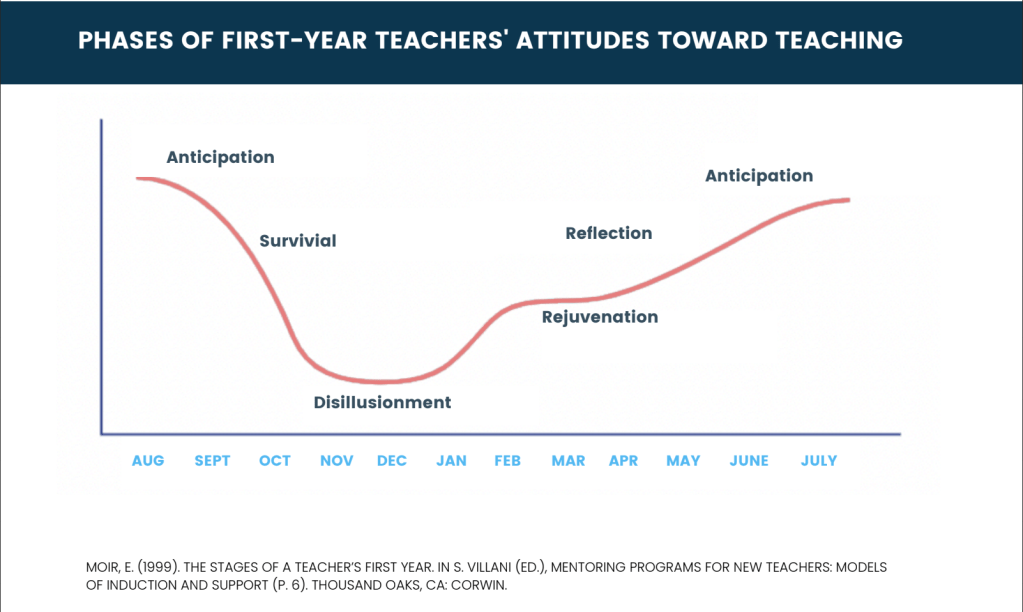
A quick overview of the phases are as follows:
- Anticipation Phase (August): This phase begins even before the school year starts. New teachers are filled with a mix of excitement and anxiety, often holding idealistic views about the difference they’ll make.
- Survival Phase (September – October): Reality sets in quickly, and the first month can feel overwhelming. New teachers are bombarded with unexpected problems and situations. They become consumed with the day-to-day routine, often working up to 70 hours a week just to keep their heads above water.
- Disillusionment Phase (November – December): After weeks of nonstop work, it’s common to hit a low point. This phase is marked by questioning one’s competence and commitment to teaching.
- Rejuvenation Phase (January – April): A shift typically begins in January, sparked by the winter break. This time off allows for rest, reflection, and planning, which brings renewed hope.
- Reflection Phase (May – June): The end of the school year is an invigorating time. Teachers can look back and identify what worked and what didn’t. A vision for their second year begins to emerge, sparking a new sense of anticipation.
The visual below helps clarify how the phases look over time. However, I always found it a bit uninspiring because that dip into Disillusionment really stands out:
Engaging in the Journey
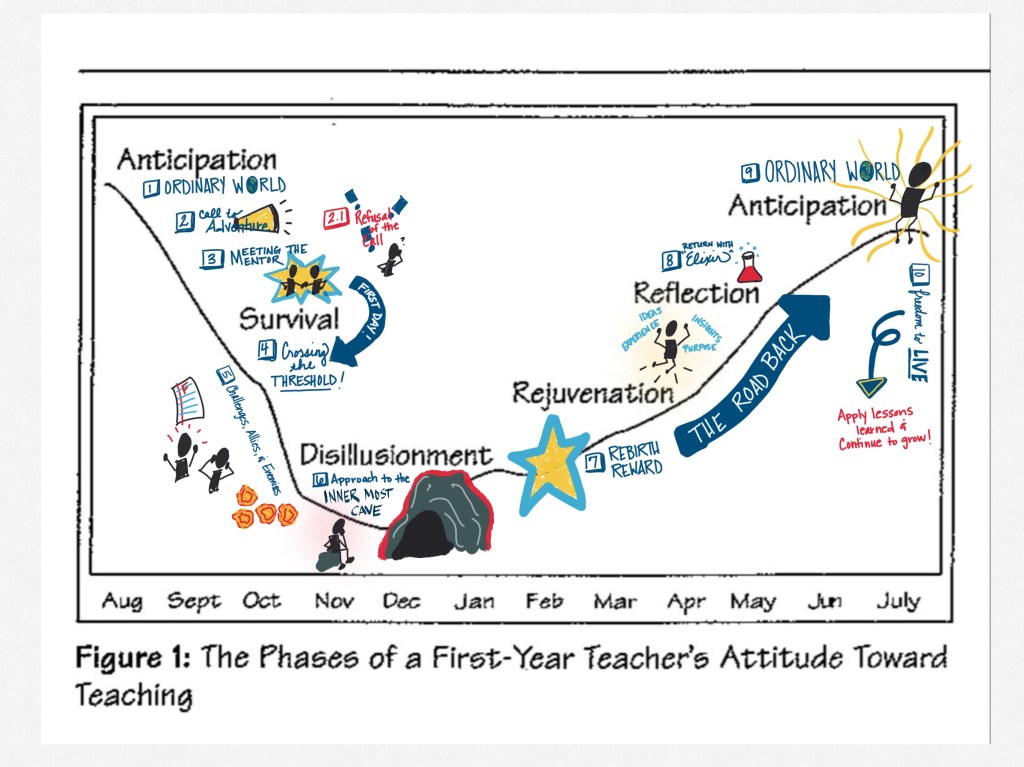
I wondered how I could make the concept of these phases more engaging for new teachers especially the visual. That’s when my English teacher background kicked in, and I realized these phases followed a similar path to Joseph Campbell’s Hero’s Journey. What if we reframed the First-Year Teacher experience as a personal journey? I took the phases for teachers and the stages of the journey and mapped them out as follows:
Departure
- Ordinary World: The enthusiastic pre-service teacher, brimming with ideas and idealism. (Anticipation Phase)
- Call to Adventure: Landing their first teaching position. (Anticipation Phase)
- Refusal of the Call: Doubts and anxieties creep in. Maybe teaching isn’t what they imagined. (Anticipation Phase)
- Meeting the Mentor: Finding a supportive veteran teacher, administrator, or colleague. (Possible overlap with Anticipation or Survival Phase)
Initiation
- Crossing the Threshold: The first day of school. Stepping into the unknown classroom. (Survival Phase)
- Tests, Allies, and Enemies: Daily challenges, building relationships with students and parents, managing behavior. (Survival Phase)
- Approach to the Inmost Cave: The most overwhelming point of the year. Feeling burned out, questioning teaching abilities. (Disillusionment Phase)
- Ordeal: Facing a major setback like a difficult student, a bad evaluation, or a lack of support. (Disillusionment Phase)
Return
- Freedom to Live: Applying lessons learned and continuing growth as an educator. (Reflection Phase leading back into a new Anticipation Phase for the next year)
- Reward: A breakthrough moment with students, positive feedback, or a sense of accomplishment. (Rejuvenation Phase)
- The Road Back: Finding strategies, learning from mistakes, and feeling a renewed sense of purpose. (Rejuvenation Phase)
- Resurrection: Overcoming setbacks and emerging stronger, more confident. (Rejuvenation Phase)
- Return with the Elixir: Returning to the “Ordinary World” as a more experienced teacher. (Reflection Phase, with the “Elixir” being the newfound skills and perspective)
I even found a way to overlay the Hero’s Journey onto the graph:
The Difference It Can Make
Something about reframing the phases into a journey gives the first year of teaching a bit more character. A new teacher follows a quest they understand all new teachers are going through. For example, it helps knowing that the Inner Most Cave is something all new teachers face and overcome. I can also go back to the journey each time we meet to remind the new teachers where they should be within the school year. It give me an opportunity to remind new teachers about the Marigolds they should have to help them through the Survival Phase as an Ally in the journey.
Additionally, using the Hero’s Journey helps break the phases of First-Year teaching into more defined steps. For example, when I meet with new teachers in October, I know to provide resources to help with challenges they face or ways to take care of themselves before they begin to approach the Inner Most Cave. Additionally, I know the first time I see them after Winter Break I can have a share out of what they reflected on and how they rested up ready for the semester ahead. They can also begin to share the “Elixir” they discovered for success in their classroom. And by the end of it all, they can approach that next Anticipation Phase building collective self-efficacy going into the next school year which can positively impact student learning. Plus, it is kind of cool to watch teachers embrace their own main character energy throughout the year.
Resources
There are plenty of books and websites and more out there to help with new teachers. Some resources address the concept of the phases. Resources I use include:
- The First Days of School by Harry K. Wong & Rosemary T. Wong
- The Classroom Management Book by Harry K. Wong & Rosemary T. Wong
- Supporting Beginning Teachers by Tina H. Boogren
- The Beginning Teacher’s Field Guide by Tina H. Boogren
- 180 Days of Self Care for Busy Educators by Tina H. Boogren
- The New Teacher Center
- Find Your Marigold
What resources do you find most useful for new teachers? I would love to see them in the Comments below.
 An Educational Cup of Tea
Leave a comment